
What have we seen in 2026?
Despite broader wage growth in Japan, salaries across the international consumer brands we work with haven’t changed a great deal over the past three years.
There has been some movement at the senior end, particularly in digital marketing and e-commerce, and increases in a few specialist areas. But most Manager-level salaries have remained fairly consistent.
Hiring has been a little weaker this year too. Nothing dramatic from our perspective, but companies have certainly become more cautious.
What’s interesting is that while the overall market has slowed, finding good bilingual people with specialist digital skills hasn’t necessarily become any easier.
Has hiring slowed in Japan?
Japan’s job openings-to-applicants ratio has fallen from an annual average of 1.25 in 2024 to 1.18 in August 2026. There are still more registered vacancies than jobseekers, but the market isn’t quite as tight as it was.
We’ve felt some of this ourselves, although the number of roles we’re working on hasn’t changed significantly.
Finding someone genuinely bilingual in Japanese and English, with strong e-commerce, digital marketing or CRM experience, remains particularly difficult. We regularly come across positions that have been open for six months, sometimes even a year.
Fewer vacancies doesn’t necessarily mean more suitable candidates.
What has happened to salaries?
Looking back at our 2024 and 2025 benchmarks, it’s surprising how little many salaries have moved.
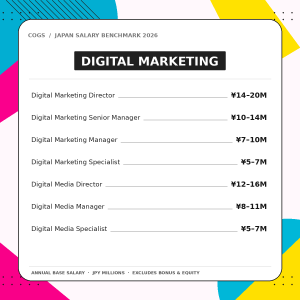
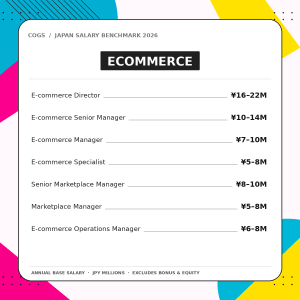
E-commerce Director salaries have increased from ¥14–18m in 2025 to ¥16–22m this year, while Digital Marketing Directors have moved from ¥12–18m to ¥14–20m.
At Manager level, things look much more similar. E-commerce and CRM Managers remain broadly within the ¥7–10m range. We’ve also seen some increases among specialists, although not across every discipline.
Companies are still prepared to stretch for the right person, particularly when someone brings a broader combination of skills.
An E-commerce Manager responsible for marketplaces, brand.com, CRM, performance marketing and revenue is quite different from someone mainly managing website operations. Both might have the same title, but they won’t necessarily command the same salary.
Why we’re separating consumer brands from consumer technology
We’ve kept large consumer-facing technology companies, such as Google and Netflix, along with B2C fintech businesses, out of this year’s benchmark. Although they compete for some of the same marketing, digital and e-commerce talent, the salary differences can be significant.
For comparable senior roles, total compensation at some of these companies can be 50–100% higher than at traditional consumer brands, particularly once bonuses and RSUs are included. With the weak yen, dollar-denominated equity can make these packages look even more attractive.
There is a trade-off, though. Global layoffs across the technology sector have affected teams in Japan too, and share-based compensation can fluctuate considerably.
Our benchmark focuses on annual base salaries within established international consumer brands across retail, fashion, luxury, outdoor, FMCG and related sectors.
What should companies consider when hiring?
While hiring has slowed, the best candidates are still in demand and can receive multiple offers.
We’ve seen companies take longer to make decisions, adding extra interviews or spending more time reviewing candidates because of economic uncertainty. Understandable, but good candidates don’t necessarily wait around. You can spend months finding someone and then lose them because the process takes too long.
It’s also important to understand the salary market you’re recruiting from. If you want someone from a major US technology company, you can’t expect to attract them with a traditional consumer-brand salary unless there’s a particularly good reason for them to move.
Hybrid working remains a strong preference among candidates we speak with, although more companies are returning to five days in the office. This can make a difference when candidates have several opportunities to choose from.
What should candidates consider?
One thing we’d encourage candidates to look at more closely is how a company is performing globally, not just in Japan.
We’ve seen international businesses performing well locally, only for global restructuring, cost reductions or changes in strategy to affect their Japan operations.
This is particularly relevant for smaller Japan subsidiaries that depend heavily on investment and decisions made at regional or global headquarters.
Understanding the wider business, its financial performance and how Japan fits into its longer-term plans is worth considering before making a move, particularly in the current market.
About our benchmark
Cogs specialises in recruiting bilingual professionals for international companies in Japan, particularly across e-commerce, digital marketing, CRM, marketplaces, creative, design and leadership.
Our figures are based on candidates we’ve interviewed, searches we’ve worked on and salaries we’ve seen over the past 12 months, alongside comparisons with our 2024 and 2025 benchmarks.
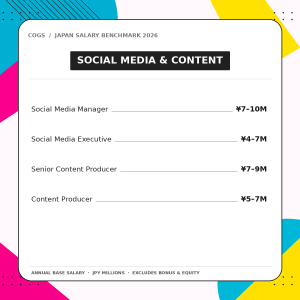
They’re intended as a practical guide to annual base salaries, excluding bonuses and equity, rather than a comprehensive survey of the Japanese employment market.


Cogs is an executive search and recruitment agency specialising in connecting creative-minded individuals with global career opportunities.
For further reading and resources, check out our blog: Cogs Agency.
Reach out by sending an e-mail to [email protected] , check out our LinkedIn page for the latest job updates and read more of our articles.
- Categories
- Job Market
- Salary Survey